Beyond the Bubble: How Public Health Organizations Can Turn Expertise Into a Sustainable Digital System
Expertise Has Little Value If It Never Leaves the Room
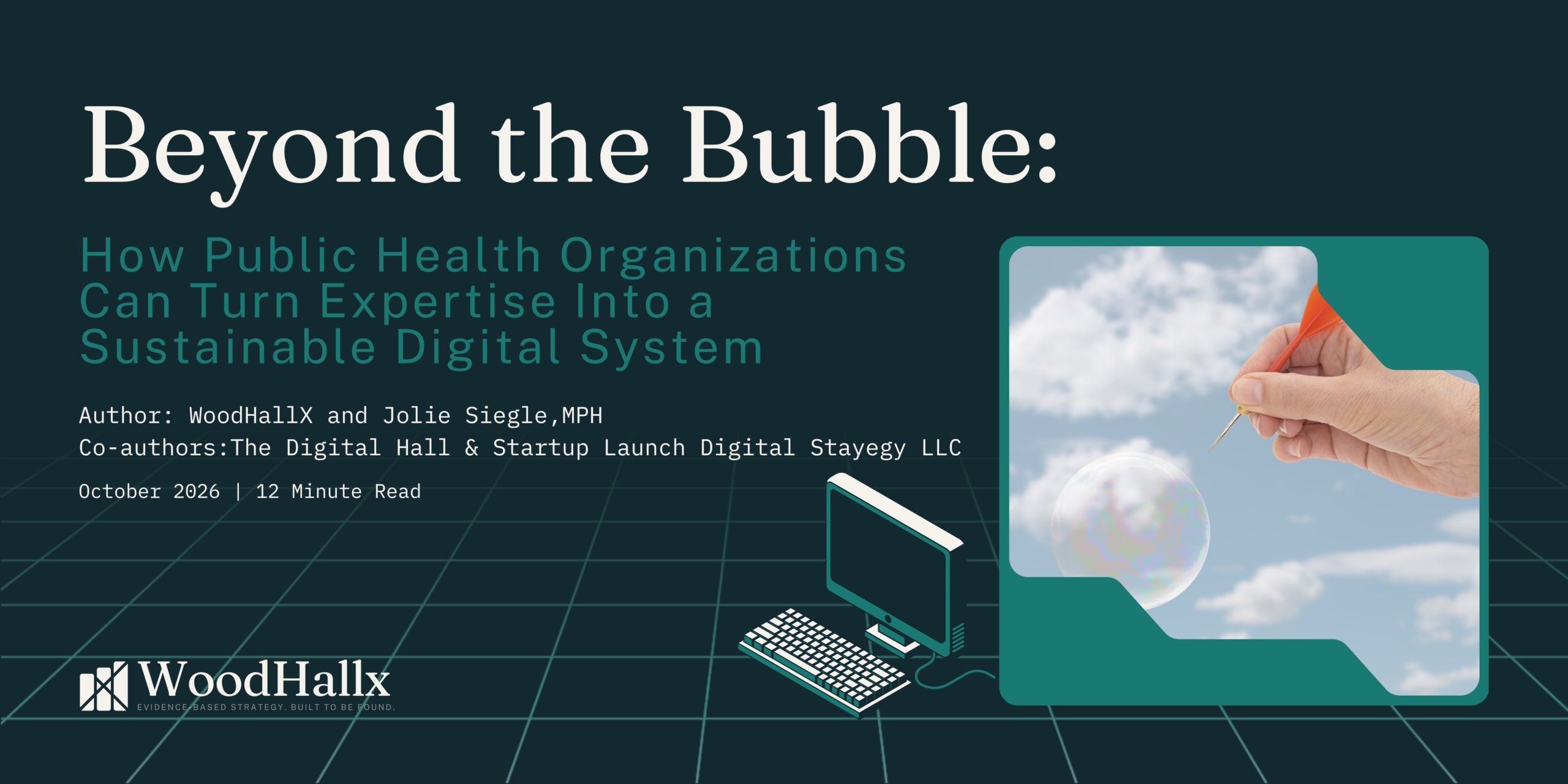
Public health organizations produce an enormous amount of valuable expertise. Researchers publish findings, experts speak on panels, coalition leaders participate in conferences, and teams develop campaigns, write reports, conduct community research, and spend hours developing recommendations that could meaningfully influence public understanding and behavior. But much of that expertise remains trapped inside the environments where it was created.
This is what we mean by the bubble. The problem is not a lack of expertise. It is the gap between having credible knowledge and building the systems required to make that knowledge visible, understandable, discoverable, and trustworthy.
That distinction matters in public health because communication is not simply a marketing function. Research on health communication consistently identifies misinformation, distrust, inconsistent messaging, and weaknesses in digital communication as barriers to effective public health communication (Bauder et al., 2023). The question, then, is not simply, “Are we producing good information?” It is, “Have we built a system that allows the right people to find, understand, trust, and act on that information?”
That is the problem behind our Beyond the Bubble work, and it is the thinking that led SLDS and The Digital Hall to develop a shared framework for turning expertise into a sustainable digital system.
The Public Health Communication Problem Is Bigger Than Content
It is tempting to define digital communication as a content problem. If an organization needs more visibility, create more posts. If engagement is low, change the creative. If the website is not performing, redesign it. If search traffic is declining, add more keywords. If AI systems are not surfacing the organization, publish more content.
Each of these responses addresses a piece of the problem. None necessarily addresses the system.
A public health organization can have excellent researchers and still have a weak digital presence. It can publish frequently and still fail to communicate its expertise. It can have an attractive website and still be difficult for people, search engines, or AI systems to understand.
That is because digital credibility is cumulative. A systematic review of health communication research found that factors affecting perceived credibility include the language used online as well as signals associated with expertise and social validation (Aghakhani et al., 2021).
Another systematic review of public health social media campaigns found that reach and engagement were among the most frequently reported measures, while two-fifths of campaigns did not measure outcomes beyond engagement (Kite et al., 2023).
In other words, being visible is not the same as being effective.
The organization needs a connected infrastructure in which its expertise can travel.
The First Step Is Getting Out of the Bubble
Getting out of the bubble does not mean turning every research finding into a viral social post. It means creating pathways between the expertise an organization already possesses and the audiences who need it.
That can involve turning conference insights into durable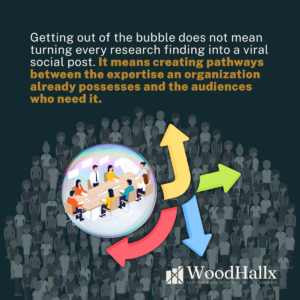 educational content, translating research into accessible explanations, connecting organizational leaders to visible areas of expertise, building websites that make the organization’s knowledge easier to discover, creating content around the questions audiences are actually asking, making the organization’s expertise legible to search engines and emerging AI systems, and measuring whether communication is contributing to meaningful outcomes rather than simply generating activity.
This requires coordination across disciplines. Technical SEO cannot, by itself, determine whether an organization is communicating the right message. Social media performance cannot, by itself, tell you whether the organization’s positioning is credible. A content calendar cannot solve an unclear website structure, and a strong brand cannot compensate for an inaccessible or poorly structured digital foundation.
The system has to work together.
Introducing the AIM Framework
That is the thinking behind the framework we have been developing collaboratively through the SLDS and The Digital Hall partnership.
We call it the AIM framework: Audit & Assess, Infrastructure development, and Measure & Sustain. AIM sits within the broader SLDS framework and was developed collaboratively with The Digital Hall to bring complementary disciplines into one connected system. Infrastructure itself unfolds in two connected phases: the hidden, back-end architecture that makes an organization legible to search engines and AI systems, and the public-facing build where that architecture becomes content, design, and voice. Both are part of the same stage; neither is complete without the other.
The important distinction is that these stages are not intended to operate as a one-time linear checklist. The framework is cyclical. Measurement feeds back into the next audit, allowing the organization to continually learn and adjust.
Here is what that looks like in practice.
-
Audit & Assess: Understand the Digital Reality Before Building
The first stage is about understanding what is actually happening. Before creating another campaign, publishing another month of content, or redesigning a website, an organization needs to know where it currently stands.
That means looking beyond a single channel. The partnership framework divides this work across complementary areas of expertise. The Digital Hall leads technical SEO, keyword and topical authority strategy, website and UX assessment, accessibility and ADA audit review, HIPAA risk review, and the technical side of AI-search visibility. SLDS leads social media performance, social SEO, keyword creation and content strategy, branding and positioning facilitation, and a website branding assessment focused on audience psychology and connection, as well as behavioral health and mental health policy subject matter expertise. SLDS and The Digital Hall also provide subject-matter expertise for AI-search visibility, including Answer Engine Optimization (AEO) and Generative Engine Optimization (GEO).
That distinction matters. Two audits can look at the same organization and identify completely different problems. A technical audit might show that a website is structurally sound but still failing to connect with its intended audience. A social audit might show strong engagement on individual posts while revealing that the overall content lacks a consistent strategic position. A keyword and topical authority assessment might identify search opportunities that an organization has the expertise to own but has never developed content around.
The objective is not to produce a long list of technical recommendations. The objective is to understand the gap between what the organization knows, what it communicates, what audiences are looking for, and what digital systems can actually surface.
-
Infrastructure Development: The Hidden Architecture and the Public-Facing Build
Once the organization understands the gaps, the next question is what needs to be built, starting with what nobody sees. Infrastructure begins with the wiring behind the walls that nobody sees but everything depends on.
Infrastructure is broader than a website. It includes the digital foundations that allow expertise to be organized, discovered, communicated, and measured. That can mean clarifying positioning, improving website structure and accessibility, developing keyword and topical authority strategies, strengthening social SEO, identifying public health content opportunities, establishing AEO/GEO and broader AI-search visibility practices, or establishing clearer relationships between organizational expertise and the questions audiences are asking.
This is also where strategy becomes important. The goal is not to create a collection of disconnected improvements. It is to establish a foundation that supports the organization’s broader mission and can continue to evolve.
This reflects the SLDS philosophy that sustainable digital systems should compound over time rather than depend on short-lived trends.
With that back-end architecture in place, the same stage carries through the public-facing build: the paint on the wall after the wiring is done. This is where many organizations fall back into the bubble. They produce excellent content when there is a conference, announcement, campaign, or funding cycle, but communication becomes reactive between those moments.
A sustainable pipeline works differently. Instead of asking, “What should we post this week?” the organization can ask, “What do we know, what questions are people asking, and how should our expertise show up across the digital ecosystem?”
That shift creates opportunities to translate one piece of expertise into multiple useful forms. A research finding might become an explainer article, a social series, a leadership post, a webinar discussion, an FAQ, or a resource for partners. A conference presentation might become a durable article that continues to answer questions long after the event ends. A recurring audience question might reveal an opportunity for a new resource or a change in website architecture.
The objective is not simply to produce more. It is to make the expertise the organization already possesses more useful and more discoverable.
For public health organizations, this also requires compliance awareness. The SLDS and The Digital Hall partnership explicitly recognizes that neither firm makes legal or platform compliance determinations. Those decisions remain with the client’s attorney. That boundary is part of the system too. Credible communication requires knowing not only what to say, but also where professional review and authorization belong.
-
Measure & Sustain: Replace Activity With Learning
The final stage asks a different question from traditional reporting. Instead of simply asking, “How many people saw this?” the organization should be asking, “What did we learn?”
Reach and engagement can still be useful indicators, but they are not automatically evidence of meaningful impact. The systematic review of social media campaigns in public health found that many campaigns measured process or engagement metrics without being able to determine whether their broader objectives had been met (Kite et al., 2023).
Measurement should therefore connect back to the organization’s original objectives. What changed? What content generated meaningful attention? Which questions remain unanswered? Where are audiences finding the organization? Where are they dropping off? Which areas of expertise are gaining visibility? Which areas remain difficult to discover? And what does all of that tell us about the next cycle?
This is why the AIM framework is cyclical. Measure & Sustain feeds back into Audit & Assess. The next audit is informed by what the organization learned from the previous cycle. The system gets smarter over time.
Why This Matters More in an AI-Driven Search Environment
The definition of “being found” is changing. Traditional search generally presented users with a list of links. Increasingly, AI-powered search experiences synthesize information into answers and may cite the sources used to construct those answers.
That creates a new challenge for organizations with specialized expertise. It is no longer enough to ask whether a website ranks for a keyword. Organizations increasingly need to consider whether their expertise is presented clearly enough, consistently enough, and authoritatively enough to be understood and referenced within emerging search environments. This is where AI-search visibility becomes a distinct discipline, including Answer Engine Optimization (AEO) and Generative Engine Optimization (GEO). SLDS provides the subject-matter expertise in this area, while The Digital Hall contributes the technical search expertise that supports the broader system.
Recent research into generative search has documented differences between traditional search and AI-generated search, including differences in the sources these systems surface and the concepts and content they present (Kirsten et al., 2025).
This does not mean organizations should start “writing for AI” at the expense of human readers. In fact, the opposite is true. Clear structure, descriptive headings, authoritative sourcing, transparent authorship, and precise language are useful because they make information easier for both humans and machines to understand.
The goal is not to game an algorithm. It is to make credible expertise easier to identify.
Upcoming Webinar: A Closer Look at the Framework
Save the date to join Startup Launch Digital Strategy and The Digital Hall for a Webinar on Wednesday, November 19. It’s a closer, more conversational look at the AIM framework than this post can offer on its own, and it doubles as a local preview: Sarah Marshall is bringing the national version of this same framework to NNPHI’s AIxPH conference in Baltimore this October.
Rather than treating technical SEO, AI-search visibility, AEO/GEO, social media, branding, content, accessibility, and measurement as independent marketing activities, the session walks through how they operate as connected parts of one system: understanding what an organization currently has, identifying the gaps, developing the infrastructure needed to close them, building a sustainable content pipeline, and establishing measurement that feeds the next cycle.
The partnership itself is designed around complementary expertise. The Digital Hall leads technical SEO, keyword and topical authority strategy, website and UX audits, accessibility and ADA assessment, and the technical search components that support AI-search visibility. SLDS leads social media audits, social SEO, keyword and content strategy, branding and positioning facilitation, audience-focused website assessment, and the subject-matter strategy behind AI-search visibility, including AEO and GEO.
Every attendee leaves with a Digital Ecosystem Self-Assessment Checklist: ten questions spanning website, social, accessibility, and AI-search visibility, written so you can evaluate your own organization without needing our methodology first. It’s a what-to-look-at, not a how-to-fix-it.
Bauder, L., Giangobbe, K., & Asgary, R. (2023). Barriers and gaps in effective health communication at both public health and healthcare delivery levels during epidemics and pandemics: Systematic review. Disaster Medicine and Public Health Preparedness. PubMed record
Aghakhani, N., et al. (2021). Assessing the credibility and authenticity of social media content for applications in health communication: Scoping review. Journal of Medical Internet Research.
Kite, J., Chan, L., MacKay, K., Corbett, L., Reyes-Marcelino, G., Nguyen, B., Bellew, W., & Freeman, B. (2023). A model of social media effects in public health communication campaigns: Systematic review. Journal of Medical Internet Research, 25, e46345.
Kirsten, E., Grosse Perdekamp, J., Upadhyay, M., Gummadi, K. P., & Zafar, M. B. (2025, October 13). Characterizing web search in the age of generative AI.